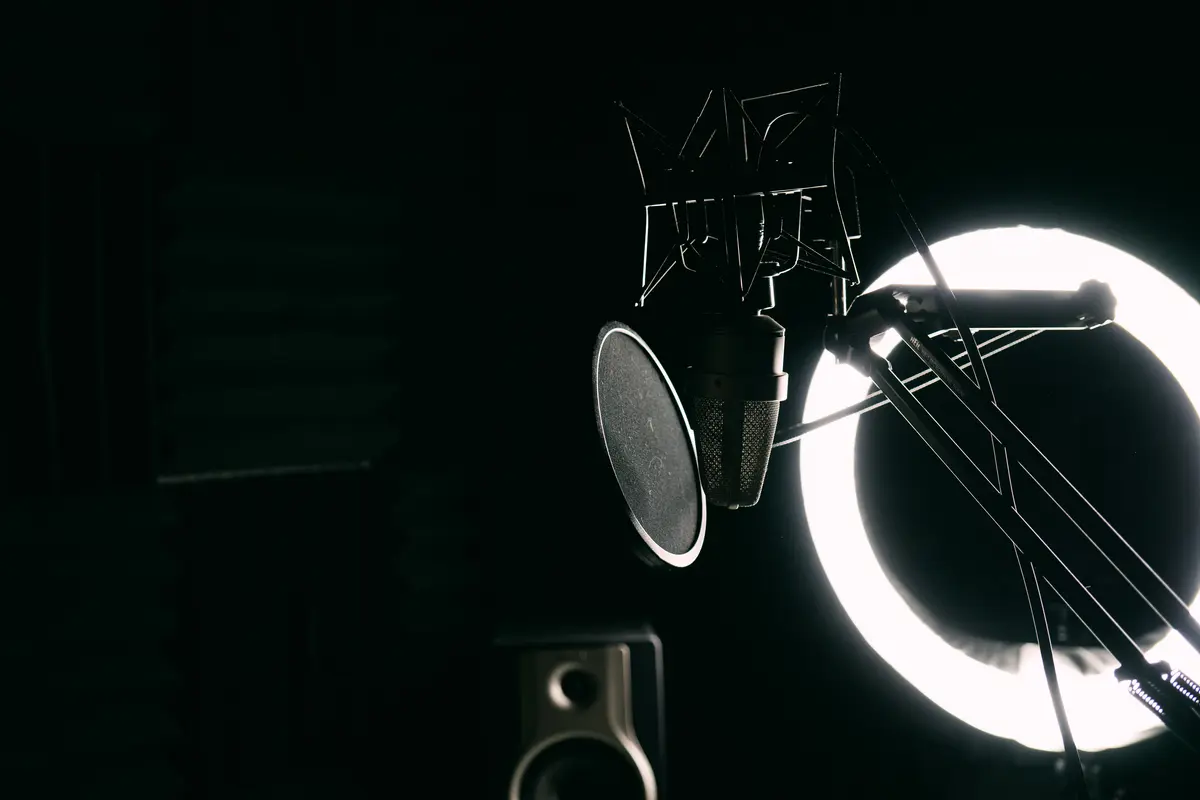
Photo credit: Jessica Lewis
Interview + Soundscape
Room Without Eyes
An interview segment with Will Butler, Be My Eyes and Byron Michael Harden on navigating rooms without sight & unraveling preexisting mental maps.
Listening player for Room Without Eyes. Interview + Soundscape. Approximately 9 minutes.
Song: Blue 33 by Byron Michael Harden aka Stico Von Drake.
Transcript — Room Without Eyes
00:00
- Will Butler, Be My Eyes
- You're very exploratory. You use your body in such a way to go into the corners of spaces, find the doors, see what's on the table. Not in a way that is like you're groping or reaching out into the abyss. And you very quietly sometimes surprise me about when you walk in a room, you already know the plant is there. You told me there's a door to my basement that I didn't even know was there. Do you think that came from your childhood?
- Byron Michael Harden
- For me, I look at as many angles as possible. And I'm putting together a roadmap in my head of where I am.
01:00
- Byron Michael Harden
- When someone says, you're going to visit Will or Will Butler, I put all that image in my head. Like, okay, this is where I was. And so, you know…
- Will Butler, Be My Eyes
- So you're just mapping all the time.
- Byron Michael Harden
- Yeah, I'm always doing that. But not only for that purpose, but I also do it because it allows me to understand. I'm really into architecture. Not super, super deep, but enough to where I care.
- Will Butler, Be My Eyes
- I heard you say that earlier because — and it kind of surprised me, because I think of architecture as so visual.
- Byron Michael Harden
- Yeah.
- Will Butler, Be My Eyes
- How can you be into architecture if you can't see it?
- Byron Michael Harden
- Well, yeah, because it tells a story a lot of times. See, I keep saying this about the training. It's like, that's what the training — like the framework of the training should tell the story that the learner has to tell.
02:00
- Byron Michael Harden
- Right, so that's why it's so highly customizable, because this is art that we're talking about.
- Will Butler, Be My Eyes
- Music and architecture are often compared, right?
- Byron Michael Harden
- I mean, always, right?
- Will Butler, Be My Eyes
- Blind people don't all have that spatial ability. I've heard lots of people say I have terrible sense of direction, I have terrible spatial awareness. Do you think that's just person to person? Everyone's different? Or do you think there are certain things you can do to help map out a space better?
- Byron Michael Harden
- Yeah, you know, I'm going to tell you something. One of the things that I found out — we found out in training — is that it's difficult for people a lot of times to know when they're in a software or when they're just in a general part of the OS. Like, just take the Mac side, for instance. You just went in the regular Finder window as opposed to being…
- Will Butler, Be My Eyes
- On the computer, yeah.
- Byron Michael Harden
- Yeah, you know, it's like, I don't know who I am. So then we'll have to pull out a topographical display that shows like, hey, this is the Finder window, and you hear this…
03:00
- Byron Michael Harden
- This is what it's doing, and this is where you will be.
- Will Butler, Be My Eyes
- You make like a physical map of the computer screen?
- Byron Michael Harden
- Yeah.
- Will Butler, Be My Eyes
- Wow.
- Byron Michael Harden
- Yeah. To show them how the interface looks, so to speak.
- Will Butler, Be My Eyes
- Yes. So that when you say you're in the Finder, they have an idea of what that is.
- Byron Michael Harden
- It's like somebody knows, I know I'm outside, I know I'm inside. It was because I'm physically touching it. Which is another reason why I explore all corners. It allows me to get a really good idea of where I am. And not just in the space, but in my head.
04:00
- Will Butler, Be My Eyes
- So when a student comes in for the first time to do the in-person training at your facility, do you encourage them — how do you encourage them to get to know the studio? What do you tell them?
- Byron Michael Harden
- The very first thing we do when we get a hand-over-hand. And this is one of the things that makes this hand-over-hand so powerful.
- Will Butler, Be My Eyes
- Hand-over-hand means like you're guiding them through it physically.
- Byron Michael Harden
- Absolutely.
- Will Butler, Be My Eyes
- The school every day.
- Byron Michael Harden
- Yep.
- Will Butler, Be My Eyes
- Immersive training.
- Byron Michael Harden
- Absolutely.
- Will Butler, Be My Eyes
- Okay.
- Byron Michael Harden
- I walk them the entire perimeter of that studio space, all the way from the front door to the back door and back to the front door. And they're like, I came here to learn about audio. You're showing me the back, you know, the dumpster?
- Will Butler, Be My Eyes
- Right.
- Byron Michael Harden
- But — and I'm talking every angle.
05:00
- Byron Michael Harden
- That takes three hours, four hours of the first day. But what they don't know is that what happens is that it unravels you from where you were before you came there. It lets that ball of yarn be loose, and now we can mold it to where it needs to be. Because in order to program someone you have to, you know — because we deal with adults, right? So we have a high level of deprogramming first, to reprogram.
06:00
- Sound
- [Spoken interview ends. Song, Blue 33 by Byron Michael Harden aka Stico Von Drake, begins: soft acoustic guitar picking with gentle hummed vocals and quiet ambient background sound, continuing without further dialogue to the end of the recording at approximately 8:47.]
Accessibility: Audio · Transcript